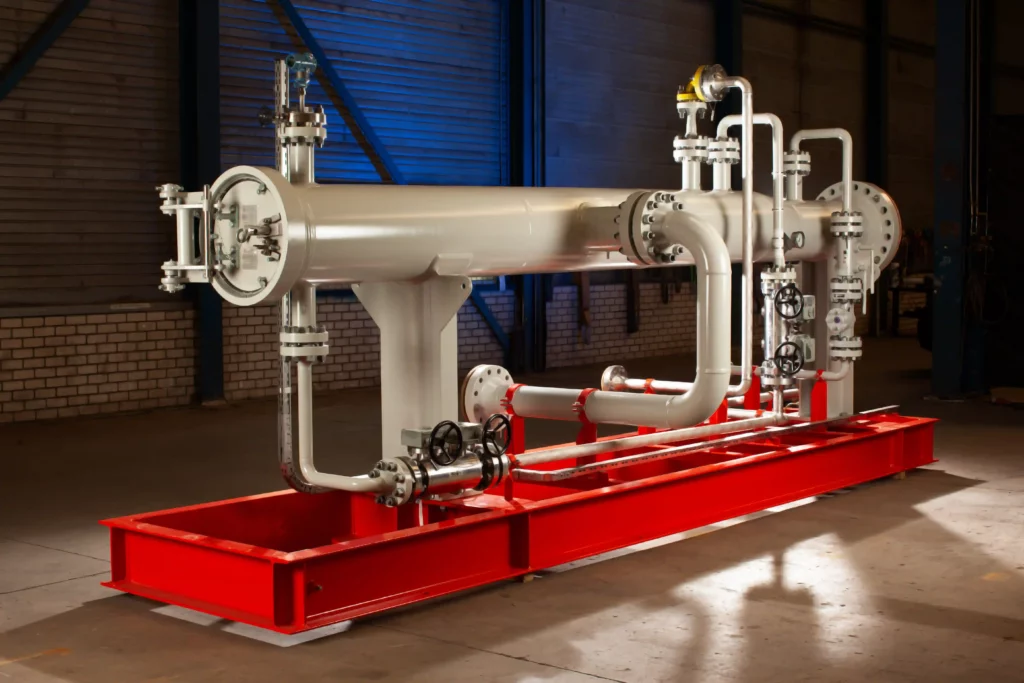
Natural gas extracted from wells contains impurities like hydrogen sulfide, carbon dioxide, water vapor, and heavier hydrocarbons that must be removed before the gas meets pipeline specifications or can be used for power generation. A modular natural gas processing plant accomplishes this through a series of specialized, prefabricated process units that work together to transform raw wellhead gas into clean, marketable product. This approach has become increasingly important as the energy industry demands faster deployment, lower costs, and greater flexibility in remote or expanding fields.
Sequential processing through integrated modules
The modular processing concept divides gas treatment into discrete functional steps, each contained within a transportable skid-mounted unit. Raw gas typically enters the plant at pressures between 10 and 70 bar and temperatures of 20 to 50°C, first passing through pre-conditioning modules that remove solid particles and liquids through filtration and coalescing. The conditioned gas then flows to acid gas removal units, where amine-based absorption systems operating at 30 to 60 bar and 35 to 50°C extract hydrogen sulfide and carbon dioxide to achieve sales gas specifications below 4 ppm H₂S.
Subsequent dehydration modules employ glycol contactors or solid desiccant beds to reduce water content, achieving dew points as low as -40°C at operating pressures of 50 to 80 bar. This prevents hydrate formation during transport and downstream processing. For gas streams containing valuable natural gas liquids, refrigeration modules cool the gas stream to temperatures between -5°C and -70°C, separating heavier hydrocarbons through controlled condensation and fractionation. The process yields methane-rich lean gas and recoverable NGL liquids. Finally, compression modules boost the residue gas to pipeline export pressures, typically 50 to 100 bar, for transport, power generation, or liquefaction applications.
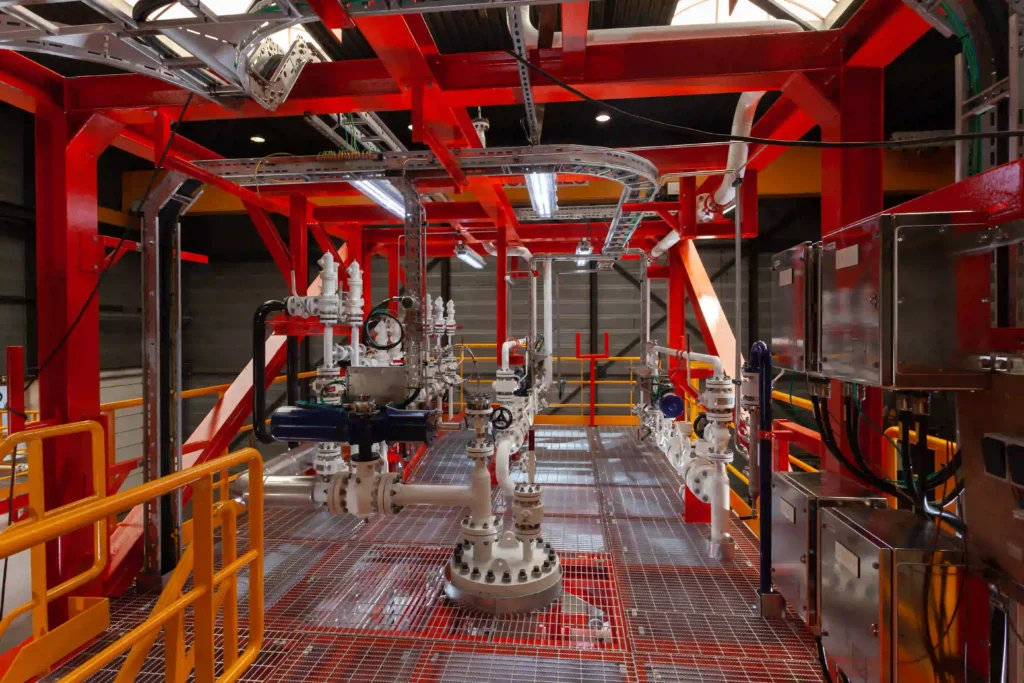
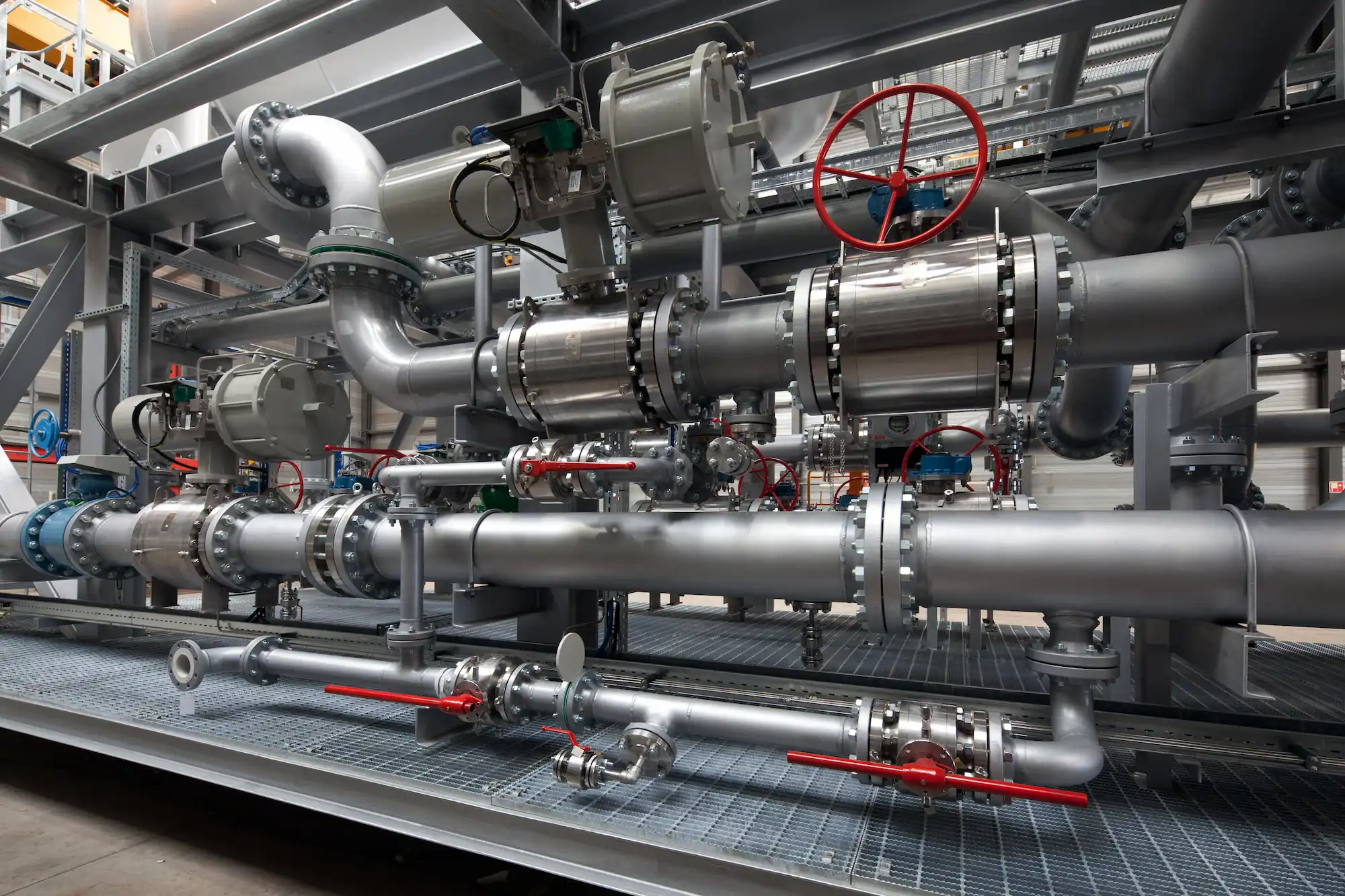
Each module is designed as a self-contained unit integrating equipment, piping, instrumentation, and control systems for its specific function. Modules interconnect via standardized flanges and pipe racks, with typical design parameters including pressures up to 100 bar, temperatures from -70°C to 100°C, and flow capacities ranging from 10.000 to 500.000 Nm³/h per processing train, scalable by adding parallel units.
FB Group’s role as system integrator
FB Group fabricates process modules in controlled factory environments, working with technology providers who supply the process designs and performance specifications. As a system integrator, FB Group handles the industrial realization: detailed mechanical engineering, steel fabrication, piping, instrumentation, controls integration, and factory acceptance testing-all within welded steel frames designed for road or sea transport. This off-site fabrication approach reduces on-site construction time by 30 to 50 percent compared to traditional stick-built facilities, while significantly improving quality control and safety through controlled manufacturing conditions.
FB Group designs and fabricates modules according to ASME VIII and EN 13445 standards for pressure vessels, with process piping meeting ASME B31.3 requirements for integrity under cyclic loads. Pressure relief systems comply with ISO 23251 standards, while welding procedures follow EN ISO 15614 to ensure leak-tightness. For installations in hazardous areas, electrical systems meet ATEX and IEC 60079 requirements for explosion-proof operation in gas zones. Standardized interfaces between modules enable rapid interconnection on-site, transforming what would traditionally require years of field construction into 9 to 18 months of total project duration, with approximately 70 percent of work completed off-site.
Advantages for technology partners and operators
This modular methodology delivers substantial benefits for both technology providers and operators. For technology licensors, FB Group offers a complete fabrication platform-from engineering through testing-without the need to invest in manufacturing infrastructure. Cost predictability improves through fixed factory pricing, eliminating weather delays and site labor variability. Projects can proceed in phases, adding processing capacity as production grows. The plug-and-play nature of properly designed modules supports applications beyond traditional gas processing, including LNG pre-treatment, CO₂ capture for storage, and industrial gas production such as hydrogen-enabling rapid deployment for associated gas monetization and flaring reduction.
For technology providers seeking an experienced fabrication partner, FB Group offers 25+ years of modular process installation expertise combined with in-house engineering and steel construction capabilities-bridging the gap between process technology and industrial-scale deployment.