In the natural gas and process industries, sour gas containing hydrogen sulfide (H₂S) and carbon dioxide (CO₂) poses significant challenges for pipeline integrity, equipment corrosion, and environmental compliance. Gas sweetening amine systems provide a proven solution to this problem, using chemical absorption processes to remove acid gases and produce pipeline-quality sweet gas. These systems are essential for conditioning natural gas from wells, refineries, and petrochemical facilities, ensuring safe transport and meeting stringent sales gas specifications.
How amine sweetening systems work
An amine sweetening system operates as a closed-loop process centered around two primary vessels: an absorber (contactor) and a regenerator (stripper). In the absorber, sour gas flows upward countercurrently to a downflowing lean amine solution-typically a 15-50% aqueous mixture of alkanolamines such as monoethanolamine (MEA), diethanolamine (DEA), or methyldiethanolamine (MDEA). The acid gases react chemically with the amine to form soluble salts (RNH₃⁺HS⁻ for H₂S and RNH₃⁺HCO₃⁻ for CO₂), while the cleaned sweet gas exits at the top with H₂S concentrations reduced to below 4 ppm and CO₂ levels typically under 2%.
The selection of amine type depends on process requirements: MEA offers high reactivity for deep H₂S removal, DEA provides moderate corrosion characteristics for balanced applications, and MDEA delivers selective H₂S absorption when CO₂ slip is acceptable. Operating pressures in the absorber typically range from 20 to 80 bar, with temperatures maintained between 30°C and 50°C to optimize absorption efficiency.
The now-rich amine solution proceeds to the regenerator, where heating to 110-130°C reverses the chemical reactions and releases the captured acid gases. The regenerator strips the acid gases overhead for routing to sulfur recovery units, flaring systems, or appropriate disposal methods. The regenerated lean amine is then cooled to 40-60°C and recycled back to the absorber, maintaining process efficiency with recycle rates exceeding 99%. This continuous regeneration distinguishes amine systems from single-use chemical treatments, enabling sustained operation with minimal solvent makeup.
System design follows established standards including ASME VIII Division 1 for pressure vessel construction and EN 13445 for unfired pressure vessels, with piping designed to ASME B31.3 specifications, ensuring safe operation across varying process conditions.
Modular integration by FB Group
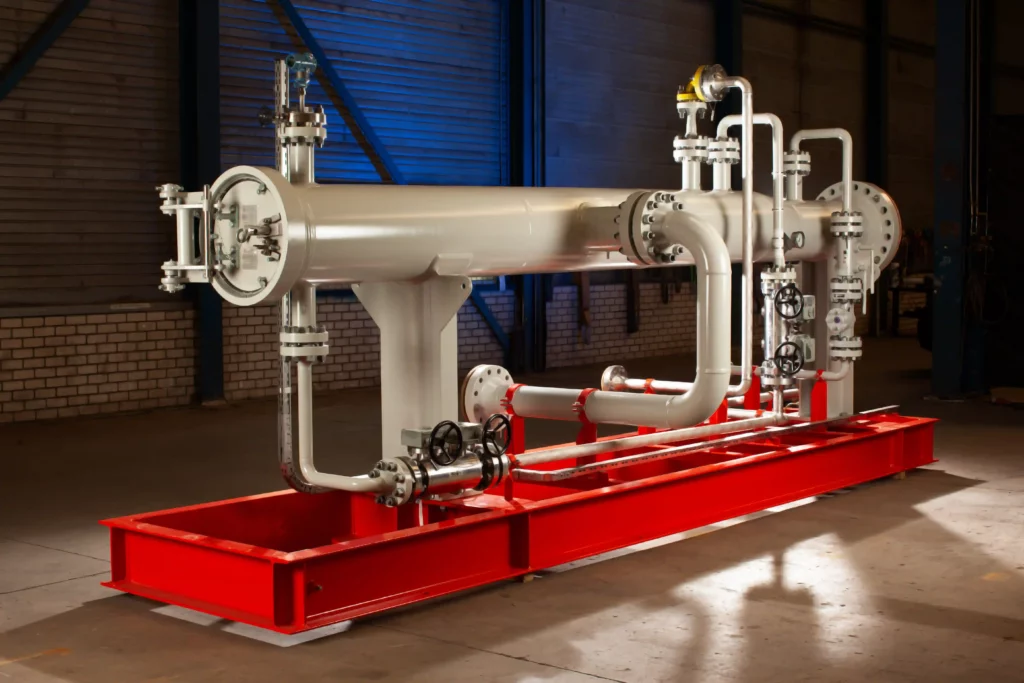
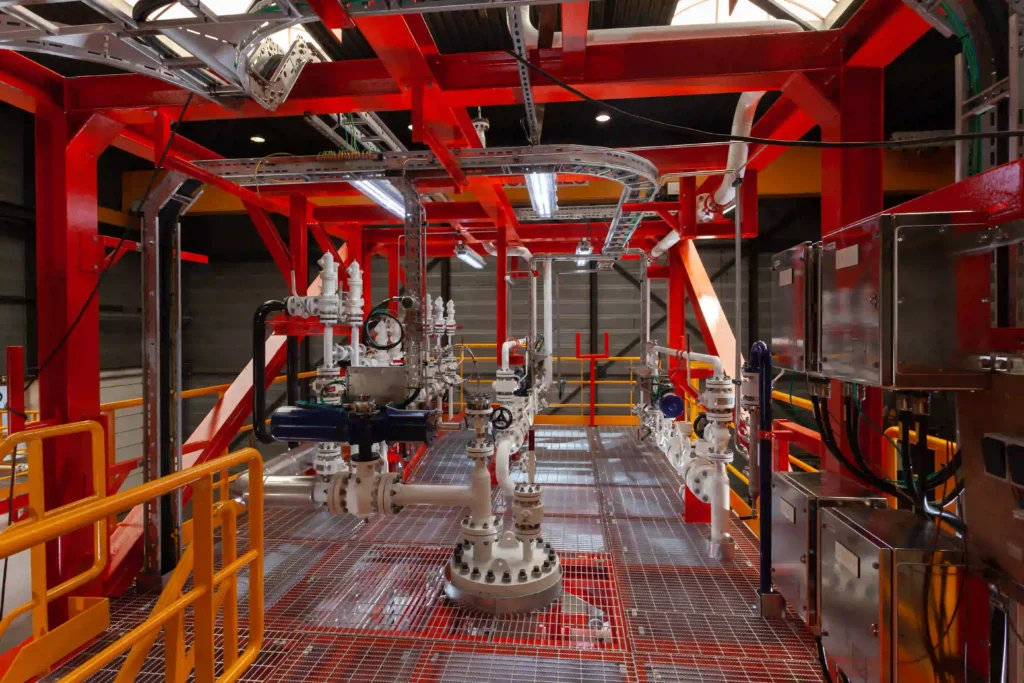
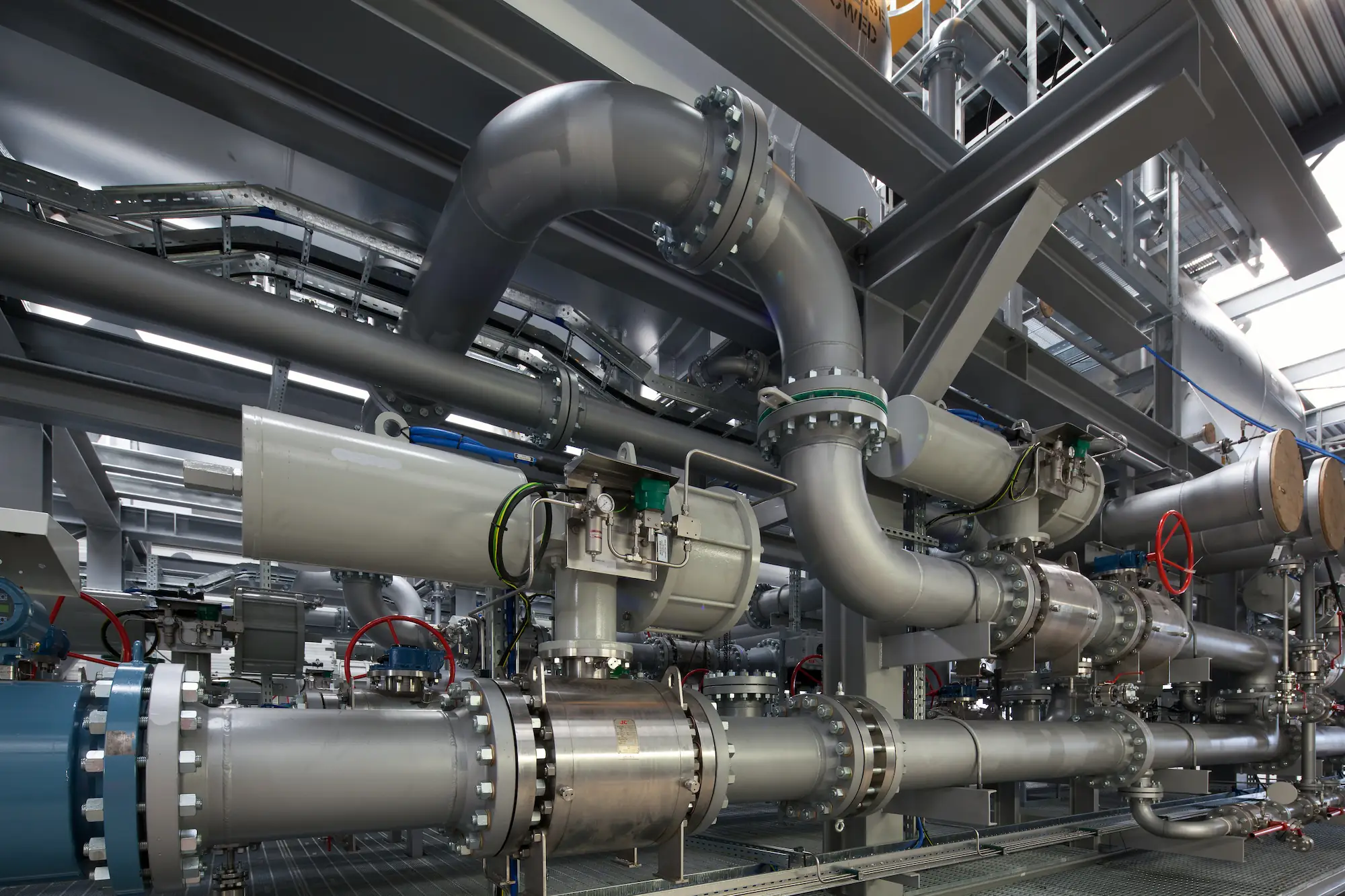
FB Group partners with gas sweetening technology providers to transform their process designs into compact, skid-mounted installations. As a system integrator with in-house engineering and steel fabrication, FB Group integrates absorbers, regenerators, circulation pumps, lean-rich heat exchangers, reboilers, and control systems onto transportable modules. This modular approach enables complete factory fabrication and testing in FB Group’s own facilities, significantly reducing field installation time and project risk-particularly valuable for remote gas processing sites, offshore platforms, compressor stations, and biogas upgrading facilities.
Modular amine units are engineered for capacities ranging from small-scale applications to substantial throughput requirements. Technology partners specify the process parameters and amine selection, while FB Group handles the mechanical design, procurement, fabrication, and quality assurance. This division of expertise allows technology licensors to deploy their gas sweetening processes across the energy transition spectrum-from conventional natural gas processing to emerging applications in associated gas treatment and carbon capture operations-without managing industrial construction.
Partnership advantages
For technology providers, this partnership model delivers multiple advantages: predictable project schedules through factory construction, reduced on-site labor requirements, enhanced quality control under FB Group’s ISO-certified fabrication processes, and flexibility for capacity expansion or relocation. FB Group’s experience with similar closed-loop process systems-including glycol contactors, regeneration columns, and heat exchange networks-ensures that the specific fabrication requirements of amine systems are addressed through proven engineering practices. Technology partners retain full control over process design, operating parameters, and performance guarantees, while FB Group provides the industrial realization expertise that bridges the gap between process technology and field-ready installations.