Amine sweetening: essential technology for natural gas processing and decarbonization
Amine sweetening is a proven chemical absorption process that removes acid gases-primarily hydrogen sulfide (H₂S) and carbon dioxide (CO₂)-from natural gas and industrial process streams. This technology transforms “sour” gas containing corrosive and toxic compounds into pipeline-quality “sweet” gas that meets strict transportation and commercial specifications. As the energy industry advances toward cleaner operations, amine sweetening has become indispensable not only for conventional gas processing but also for emerging applications in hydrogen purification and carbon capture.
The importance of this process extends beyond product quality. Untreated sour gas causes severe pipeline corrosion, poses safety hazards, and fails to meet regulatory standards that typically require H₂S levels below 4 parts per million and CO₂ concentrations under 2-5 mol%. For operators across the oil and gas value chain-from wellhead processing to midstream facilities and refineries-amine sweetening represents a critical step in delivering safe, marketable energy products. The technology is also essential for the rapidly growing carbon capture and storage (CCS) market, where reliable CO₂ removal is fundamental to decarbonization strategies.
How amine sweetening works
The process operates as a closed-loop system centered on two primary vessels: an absorber (contactor) and a regenerator (stripper). This configuration enables continuous treatment while recovering and reusing the amine solvent.
The absorption process
In the absorber column, sour gas enters at the bottom and flows upward, encountering a countercurrent stream of lean amine solution descending from the top. The amine-typically an aqueous solution containing 15-50% by weight of alkanolamine compounds-chemically reacts with acid gases to form water-soluble salts. This chemical reaction provides superior selectivity compared to physical absorption methods, allowing precise removal of target contaminants while leaving desirable hydrocarbons intact.
Operating conditions in the absorber typically range from 20-100 bar pressure and ambient to 50°C temperature. The treated sweet gas exits overhead, while the amine solution, now “rich” with absorbed acid gases, flows to the regeneration system.
Regeneration and solvent recovery
The regenerator reverses the absorption chemistry through heat application. Rich amine is heated to 110-130°C in a reboiler operating at approximately 1,7-2 bar, breaking the chemical bonds and releasing concentrated acid gas overhead. This acid gas stream is directed to sulfur recovery units, flare systems, or CO₂ sequestration facilities depending on composition and site requirements.
The regenerated lean amine is cooled to 35-50°C and recirculated to the absorber, completing the cycle. Cross-heat exchangers between rich and lean streams recover 60-80% of the thermal energy, significantly reducing operating costs.
Amine selection
Different alkanolamine compounds offer distinct performance characteristics:
Monoethanolamine (MEA) provides highly reactive H₂S removal but exhibits higher corrosion rates, making it suitable for applications with lower flow rates and high selectivity requirements.
Diethanolamine (DEA) offers moderate reactivity with reduced corrosivity, delivering balanced removal of both H₂S and CO₂ for general-purpose applications.
Methyldiethanolamine (MDEA) demonstrates preferential selectivity for H₂S over CO₂ with lower energy consumption, making it ideal for high-CO₂ streams, particularly when combined with chemical activators to enhance CO₂ capture rates.
FB Group’s modular amine sweetening solutions
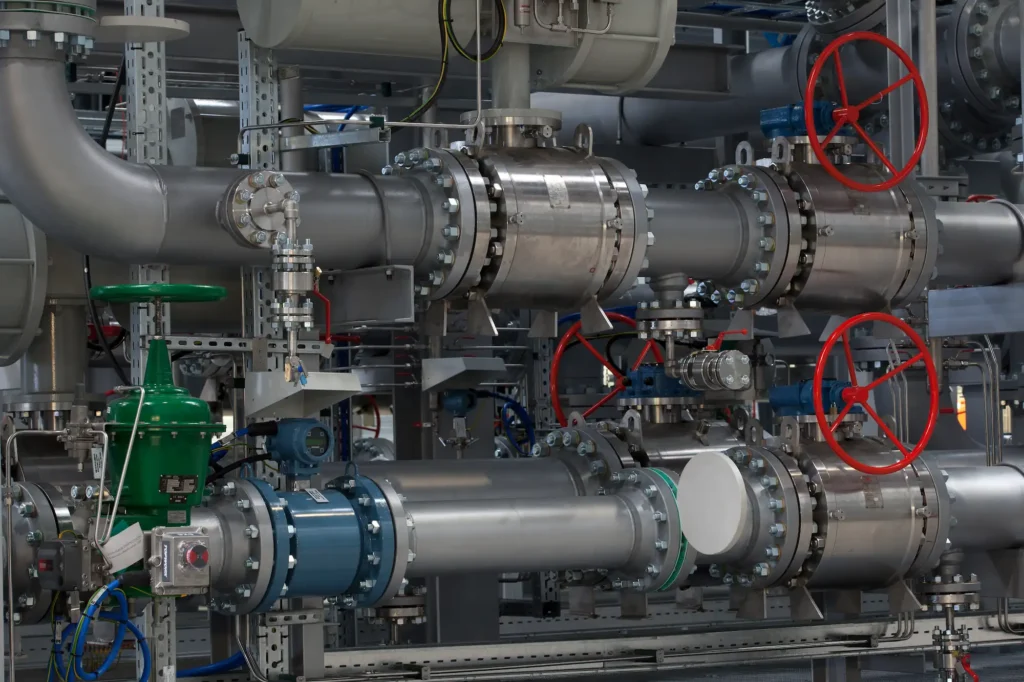
FB Group specializes in delivering amine sweetening technology through skid-mounted process units that bring significant advantages to gas processing operations worldwide. The compact, self-contained design of amine systems-with their defined absorber-regenerator configuration and standardized ancillary equipment-translates exceptionally well to modular fabrication.
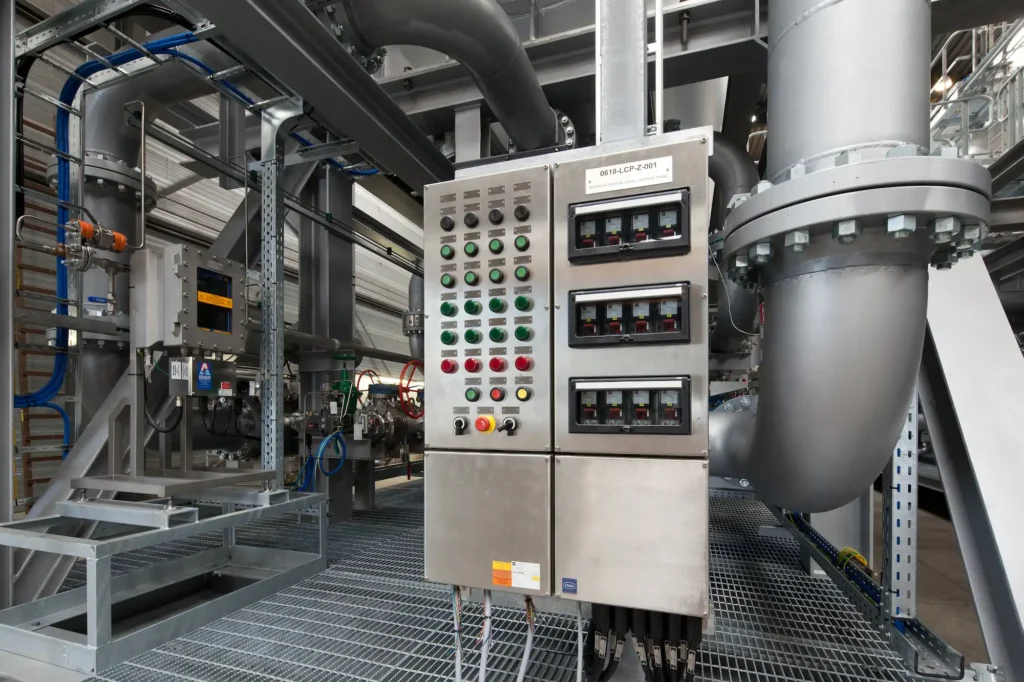
These pre-engineered units arrive at site with integrated pumps, heat exchangers, instrumentation, and safety systems already installed and tested. Capacities ranges vary from small remote facilities to substantial processing plants. The modular approach enables fabrication in controlled workshop environments where quality, safety, and efficiency exceed field construction standards.
For operators, this translates to accelerated project schedules, reduced on-site labor requirements, and faster production startup. FB Group’s amine sweetening skids support both conventional natural gas operations and emerging energy transition applications, including biogas upgrading, hydrogen purification from syngas streams, and CO₂ capture systems for carbon management initiatives.
Benefits for the energy industry
Modular amine sweetening units deliver measurable advantages across technical and commercial dimensions. Prefabrication can reduce capital expenditure by 20-40% compared to stick-built installations while compressing construction schedules by months. Advanced turndown capabilities-up to 50:1 in modern designs-provide operational flexibility for variable feed compositions and flow rates common in mature fields or seasonal operations.
The technology’s adaptability positions it as a bridge between traditional hydrocarbon processing and decarbonization objectives. The same fundamental chemistry that removes H₂S from natural gas also purifies hydrogen streams and captures CO₂ for sequestration or utilization, enabling operators to leverage proven technology for multiple energy transition pathways.
Compliance with established standards including ASME B31.3 for process piping, API 521 for pressure relief systems, and NACE SP0472 for corrosion control ensures these units meet rigorous safety and performance requirements across global jurisdictions.
Conclusion
Amine sweetening remains a cornerstone technology for gas processing while evolving to support hydrogen production and carbon capture applications. FB Group’s expertise in modular, skid-mounted process units makes this proven chemistry accessible for diverse applications-from remote wellhead facilities to integrated energy complexes-delivering the reliability, efficiency, and flexibility that modern energy operations demand.