Natural gas extracted from wells often contains undesirable acid gases-primarily hydrogen sulfide (H₂S) and carbon dioxide (CO₂)-that make it “sour” and unsuitable for pipeline transport or commercial use. Amine sweetening, also known as amine gas treating, is the industry-standard regenerative chemical absorption process that removes these contaminants, transforming sour gas into pipeline-quality sweet gas that meets strict specifications of less than 4 ppm H₂S and typically 2-5% CO₂. This proven technology is essential not only for conventional natural gas processing but increasingly for energy transition applications including biogas upgrading and low-carbon gas conditioning.
How Amine Sweetening Works
The process operates as a closed-loop system with two fundamental stages: absorption and regeneration. In the absorption tower (contactor), sour gas flows upward through a packed or trayed column, encountering a downward countercurrent stream of lean amine solution-typically an aqueous alkanolamine mixture at 15-50% concentration. Operating at temperatures between 20-60°C and pressures ranging from 20-100 bar, the acid gases react exothermically with the amine to form water-soluble salts (such as RNH₃⁺HS⁻ for hydrogen sulfide and RNH₃⁺HCO₃⁻ for carbon dioxide). This chemical reaction mechanism is what differentiates amine sweetening from purely physical absorption processes, providing superior removal efficiency even at low acid gas partial pressures.
The resulting rich amine solution, now laden with captured acid gases, exits the absorber bottom and moves to the regeneration stage (stripper). Here, the solution is heated to 100-130°C in a reboiler at lower pressure (typically 1,5-2,5 bar), reversing the chemical reaction and releasing a concentrated acid gas stream. These gases can be vented, flared, or-more commonly in modern installations-directed to a sulfur recovery unit for conversion to elemental sulfur. The regenerated lean amine is then cooled to 30-50°C and recirculated to the absorber, completing the cycle with typical circulation rates of 0,1-0,5 Nm³ amine per Nm³ of gas treated.
Different amine types offer distinct performance characteristics: primary amines like monoethanolamine (MEA) provide high reactivity for applications with elevated H₂S concentrations, secondary amines such as diethanolamine (DEA) offer balanced performance for mixed acid gas streams, while tertiary amines like methyldiethanolamine (MDEA) enable selective H₂S removal with significantly lower regeneration energy requirements-a critical advantage for modular installations with limited heat integration opportunities.
Modular Integration by FB Group
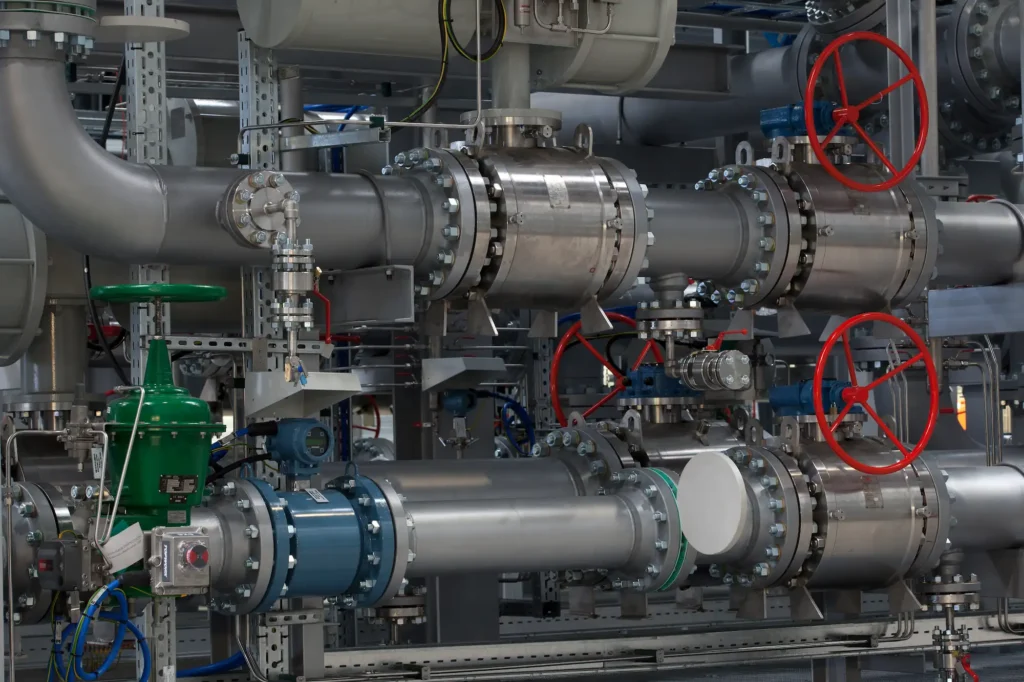
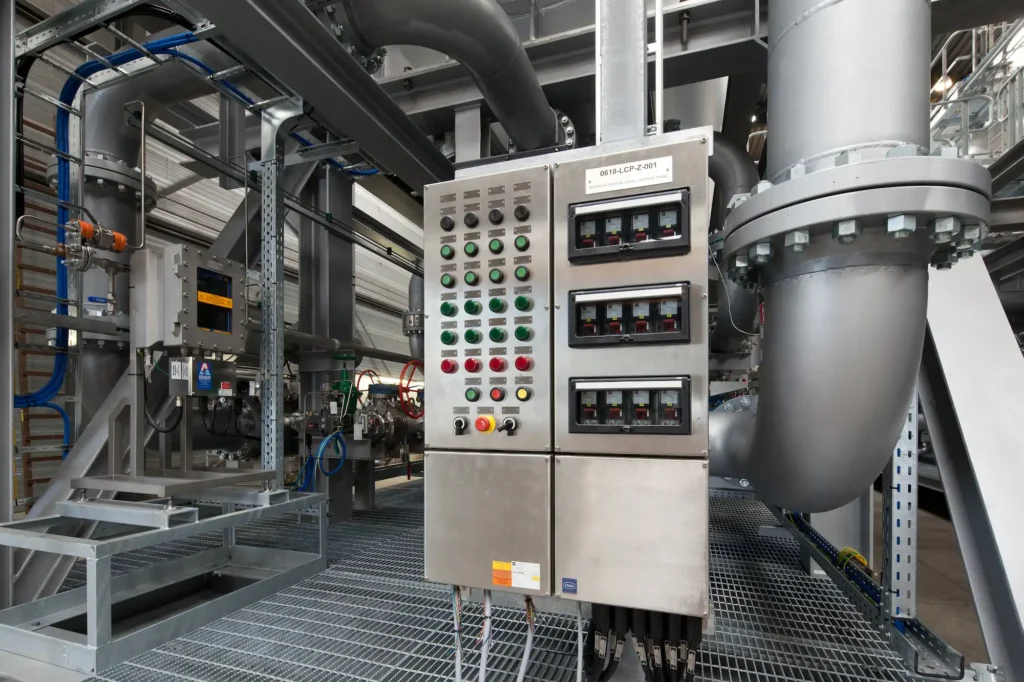
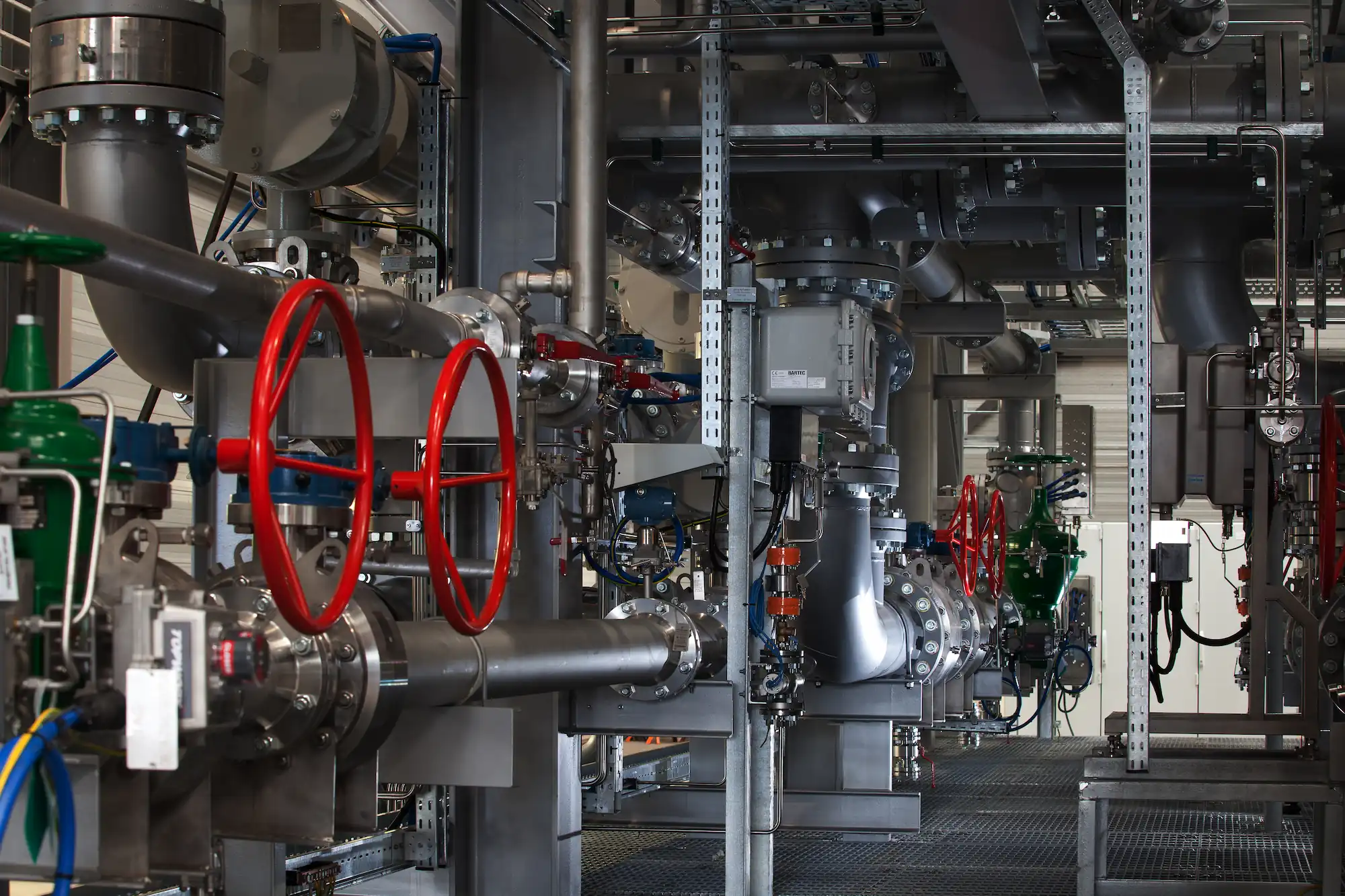
FB Group partners with amine technology providers to transform their process designs into fully integrated, skid-mounted installations. As a system integrator with in-house engineering and steel fabrication capabilities, FB Group handles the complete industrial realization-from detailed mechanical design through procurement, fabrication, piping, instrumentation, and controls integration. The resulting modules-integrating absorbers, regenerators, pumps, heat exchangers, and filtration systems on transportable skid frames-are built to European standards including EN 13445 for unfired pressure vessels and ASME Section VIII Division 1 for critical pressure equipment, ensuring compliance across international projects.
This partnership model enables technology licensors to deploy their amine sweetening processes at remote wellhead locations, offshore platforms, compressor stations, and biogas facilities without the need to manage industrial fabrication themselves. FB Group’s experience with similar closed-loop process systems-including glycol dehydration and other gas conditioning technologies-ensures that the specific requirements of amine sweetening equipment, such as corrosion-resistant materials, proper heat integration, and reliable regeneration system design, are addressed through proven fabrication practices.
Partnership Advantages
For technology providers, partnering with FB Group offers a proven path from process design to industrial deployment. Modular fabrication in FB Group’s own facilities reduces project timelines, ensures factory-quality construction under controlled conditions, and provides standardized interfaces for straightforward site integration. FB Group accommodates the specific design considerations of amine systems-including material selection for corrosion resistance, flash drum and filtration system integration (typically to less than 10 µm), and cross-heat exchange optimization for energy efficiency.
Technology partners benefit from FB Group’s 25+ years of experience in building process installations for the energy sector. This track record means technology providers can focus on their core process expertise-amine selection, operating parameter optimization, and process guarantees-while FB Group handles the engineering, fabrication, and quality assurance required for reliable industrial operation. For energy transition projects, this collaborative approach enables economical deployment of amine sweetening at distributed facilities where conventional infrastructure would be cost-prohibitive.
By combining specialist amine process technology from experienced technology partners with FB Group’s modular fabrication and system integration expertise, acid gas removal installations can be delivered efficiently and reliably-supporting both conventional gas processing and emerging energy transition applications.